
By Kate Scarlata, MPH, RDN, and Megan Riehl, PsyD

In This Article
Living life with irritable bowel syndrome is, well, irritating.
Many patients say things like, “If my IBS is behaving, my mood is good, I don’t have brain fog or anxiety, and I can enjoy my life. If I’m having symptoms, they impact my mood and make me more likely to feel depressed, on edge, and frustrated.”
These patient reactions are not surprising since irritable bowel syndrome often coexists with psychological symptoms— a bidirectional relationship rooted in the strong connection between the gut and brain.
Irritable Bowel Syndrome Primer
What is irritable bowel syndrome (IBS), anyway? Let’s take a quick look at this often misunderstood condition. IBS is a chronic and potentially debilitating gastrointestinal (GI) disorder characterized by abdominal pain and a change in bowel habits.
The pain experienced in irritable bowel syndrome is often described as cramping with variable intensity that flares frequently. It’s the most common reason to seek help from a gastroenterologist, accounting for up to fifty percent of GI doctor visits. If you have IBS—or suspect that you might—you certainly are not alone. IBS afflicts about eleven percent of the global population and about forty-five million people in the United States.
More than twice as many women as men are diagnosed with this condition, and it most often affects people between twenty and thirty years old.
While irritable bowel syndrome has no single cause, factors such as stress, food sensitivities, antibiotic use, and even early-life trauma can contribute—affecting both the gut and brain, primarily through the gut-brain axis.
The strong link between the gut and brain highlights the importance of a personalized, patient-centered treatment approach that addresses both the physical and psychological (mind-body) dimensions of IBS.
Specifically, a GI dietician can help customize a nutrition plan to manage diet-related digestive distress, while a GI psychologist can help gain insights into how life events and stress can affect the way the brain and gut communicate. Recent research shows that collaborating with an integrated team of IBS experts—a GI dietician, GI psychologist, and a gastroenterologist—leads to improved clinical outcomes and reduced healthcare costs, compared to working with a gastroenterologist alone.
Closer Look: Managing IBS with GI Psychology
Living with irritable bowel syndrome is like walking on a balance beam. You require a bit more structure and good form to avoid falling compared to someone without IBS. You can stay in line and balance on the beam with some careful adjustments, but certain triggers may tip you off the beam. The fall represents a flare-up: a period when symptoms such as excessive gas, constipation, diarrhea, and abdominal cramps become more intense and difficult to manage.
One important lesson you can learn from GI psychologists is that when a flare-up strikes, give yourself some grace. Allow a fall from the beam to be a learning moment for you to identify what may have led to the fall. You might have been enjoying a few more cocktails than usual, or maybe you didn’t notice that you hadn’t had a cleansing bowel movement in a while, or your stress level is over the top. When you see patterns emerging that tend to result in a flare, take note and dial back on your diet, ramp up on your bowel elimination program, or simply make more time to rest and relax.
When considering gut-brain behavioral therapy, it’s important to remember that irritable bowel syndrome presents in diverse ways and is often triggered by different things. For this reason, a personalized approach yields the best results—one that centers on you, taking into account your unique triggers, symptoms, history, values, and motivators. Here are our three go-to evidence-based behavioral therapies that can be personalized to effectively soothe both your tummy and stress:
Diaphragmatic Breathing
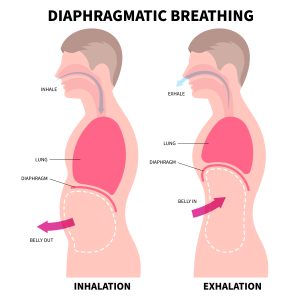
In a study at the University of Michigan, we asked patients undergoing brain-gut behavioral therapy which stress-relief techniques they found most effective and would continue using. An overwhelming ninety-one percent cited diaphragmatic breathing.
It’s free, easy, and ever-present. Diaphragmatic breathing—also referred to as belly breathing or relaxed breathing—offers several benefits for those with IBS. Of note, it is also beneficial for other GI concerns, such as heartburn associated with gastroesophageal reflux disease (GERD).
During times of stress or discomfort, our breathing tends to naturally become short, shallow, and even constrictive. The diaphragm is a muscle that sits under the lungs. If you run your hands under your ribs, you will get an idea of where it is located. The activation of the diaphragm through deep breathing can aid with abdominal pain or cramping, bowel urgency, bloating, constipation, and, as mentioned previously, uncomfortable reflux symptoms.
Adding diaphragmatic breathing to your IBS wellness toolkit will provide you with an on-the-spot coping strategy to activate your body’s relaxation response whenever you need it most. It’s a truly wonderous intervention!
Take diarrhea and bowel urgency, for example. Diaphragmatic breathing can assist in those moments of panic, such as when you are stuck in traffic or struck with the urge to go in public, and there’s not a bathroom in sight. Panic and anxiety will only worsen urgency. Remember what we discussed earlier? Stress speeds up intestinal motility (how fast or slow stool moves through the gut), so purposefully shifting to slow, diaphragmatic breathing can help calm and slow down the digestive tract.
Not surprisingly, diaphragmatic breathing is also helpful if you are constipated. When someone is constipated, they may experience frustration, stress, and even panic related to the desire or urge to have a bowel movement, only to experience the dread of an incomplete BM. These emotions, coupled with straining to defecate, can really wreak havoc on the body and mind.
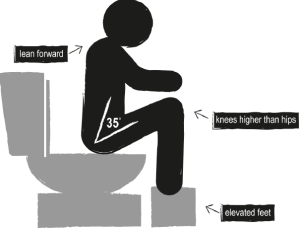
Let’s pause for a moment to explore how to improve bowel movements using diaphragmatic breathing techniques. First, engage the proper pooping position needed for a healthy bowel movement. Rest your feet on a low stand (such as the Squatty Potty). This position is designed to keep your knees above your hips. Now, with a straight spine, lean slightly forward to about a thirty-five-degree angle. (see image).
Next, while maintaining this position, begin diaphragmatic breathing, which can soothe, relax, and massage your colon and other digestive organs while engaging the pelvic floor muscles. This helps to move the stool out for an easier and more complete bowel movement.
Becoming comfortable with a daily diaphragmatic breathing practice is a great nonpharmaceutical option for improving your overall digestive symptoms and well being. For a helpful demonstration of diaphragmatic breathing by Dr. Riehl, visit the following website: www.youtube.com/watch?v=UB3tSaiEbNY
Hypnosis for IBS (Don’t Worry,
There’s No Clucking Like a Chicken)
Here’s another popular and effective psychological intervention for irritable bowel syndrome: hypnotherapy. (If you’re skeptical, hear us out!) Gut-directed hypnosis helps to restore the brain’s everyday regulation of the GI tract and has one of the highest success rates of any treatment, based on many research studies. It can improve IBS symptoms and quality of life with results shown to last years.
Surprisingly, gut-directed hypnotherapy has been studied in the use of GI conditions, most commonly IBS, for nearly four decades. Numerous research trials have shown the benefits of using this technique with IBS patients, no matter how symptoms present. That’s right, regardless of diarrhea, constipation, or both, over half of all people who have experienced inadequate relief with traditional medical treatment have had relief with hypnotherapy.
Further, gut-directed hypnotherapy has a better track record than the available medication options for the treatment of irritable bowel syndrome (symptoms often return if you discontinue use of the medication). With hypnotherapy, eighty percent of those who experienced improvements in their symptoms at the end of treatment maintained those improvements for years after their last hypnosis session.
Beyond bowel symptom relief, patients typically also experience many of the benefits provided by other relaxation and self-care strategies, including improvements in quality of life and a decrease in non-GI symptoms such as headaches, backaches, urinary problems (eg, frequent urination, urinary incontinence), and fatigue.
One of the biggest reasons why most people have not tried or even heard of gut-directed hypnotherapy for their irritable bowel syndrome is due to limited access to trained GI mental health professionals who administer it. Fortunately, people can now access this treatment in reliable ways online. From the comfort of your home, you can try gut-directed hypnotherapy by downloading an app to your smartphone. We like Nerva—an app offering evidence-based hypnotherapy techniques designed to be used over a six-week period for fifteen minutes per day.
Patients who complete the program achieve results similar to those who undergo in-person treatment. Online group classes in gut-directed hypnosis have also demonstrated effectiveness.
With hypnotherapy, the patient is guided safely and comfortably into a specific mental state (hypnosis). What sets this form of relaxation training apart is its focus on the subconscious mind—a part of the mind we’re typically unaware of. In contrast, the conscious mind is where we actively process thoughts and feelings in the present moment.
During a hypnotic state, you remain aware of your surroundings, but the conscious mind takes a backseat, allowing the subconscious to become more receptive to the gut-soothing and healing suggestions delivered during the session. The suggestions are accompanied by peaceful imagery to illustrate and reinforce the desired therapeutic change, which in IBS includes improvements in gut function.
For example, you might be asked to imagine your digestive tract as a stream and modify the flow of the water according to your needs—that is, decrease the flow if you have diarrhea or increase it if you have constipation. Additional treatment goals might include reducing the frequency and intensity of irritable bowel syndrome distress, normalizing bowel activity, decreasing the reactivity of the GI tract to life stressors, and improving your overall physical quality of life. Hypnotherapy really gets at the miscommunication between the gut & brain, and its ability to normalize the center pain-processing patterns is impressive.
Although hypnosis may seem a bit unconventional, most people find the experience to be comfortable and even pleasurable. You may think that you are not someone who could be hypnotized. However, most people are hypnotizable to a degree. Have you ever spent your commute home daydreaming, arrived at home as though your car were on autopilot, and couldn’t remember much of the drive? That’s like a hypnotic trance.
Although hypnosis may seem a bit unconventional, most people find the experience to be comfortable and even pleasurable. You may think that you are not someone who could be hypnotized. However, most people are hypnotizable to a degree. Have you ever spent your commute home daydreaming, arrived at home as though your car were on autopilot, and couldn’t remember much of the drive? That’s like a hypnotic trance.
You will want to ensure that the provider uses an evidence-based gut-directed hypnotherapy protocol, and they are a licensed health professional.
Move Your Body, Soothe Your Gut
In the stillness of hypnotherapy or diaphragmatic breathing, you learn to be with your body in a way that releases stress and tension, which is important for digestive health. But it is also important to get moving. No matter the type of irritable bowel syndrome you experience, a consistent exercise routine can help.
In times of stress, the neuroendocrine response produces chemicals, such as adrenaline, which can worsen irritable bowel syndrome. Physical activity can counteract those effects and positively affect brain plasticity. That is, the brain can actually rewire itself as a result of engaging in new, healthy behaviors. Exercise can also help protect against worsening irritable bowel syndrome symptoms. Increasing your physical activity changes gas transit and colonic transit, which can contribute to symptom improvement.
If exercise is not a regular part of your week, you can change that! You just need to find an activity that brings you joy. Begin with chair-based yoga, gentle stretching, or walking, or put on some music and dance in your kitchen while the banana pancakes are cooking. Researchers have shown that any form of moderate physical activity—engaged in three times per week for periods ranging from twenty to sixty minutes—can improve the severity of IBS symptoms.
Of note, consistency in your exercise activity is key; our patients have seen sustained positive effects not only on their IBS symptoms but also on their quality of life, fatigue, anxiety, and other mood symptoms. The answer to the question “What type of exercise should I do?” is “Whichever one you like and will stick with.” Even walking is a great option to improve both mental and gastrointestinal health.
In fact, a 2023 study published in the Journal of Clinical Medicine explored the effects of a twelve-week moderate aerobic exercise program on both gastrointestinal symptoms and psychological well being in individuals with irritable bowel syndrome. The study involved forty irritable bowel syndrome patients (18 to 65 years) who participated in a structured aerobic exercise regimen, such as group walking (speeds ranging from 5 to 10 km/h), for approximately thirty to sixty minutes, three to five times per week.
All patients underwent GI visits, physical examinations, blood tests, and psychological screenings and completed a Gastrointestinal Symptom Rating Scale questionnaire. The findings revealed significant improvements in both physical and mental health, with participants reporting reduced IBS symptoms, including abdominal pain, bloating, and irregular bowel movements. Additionally, the exercise program led to psychological improvements, with decreases in anxiety, depression, and somatization levels commonly associated with irritable bowel syndrome.
This research underscores the potential of moderate aerobic exercise as a cost-effective, non-pharmacological therapeutic tool for managing irritable bowel syndrome symptoms holistically, addressing both gut health and the mind-body connection.
While preliminary, the results emphasize the value of incorporating regular physical activity alongside psychological support and dietary adjustments into a personalized IBS treatment plan. With the correct team in place, all of you can work effectively together to determine appropriate next steps on your healing journey.
_________________________________________
Kate Scarlata, MPH, RDN, is a New York Times bestselling coauthor of 21 Day Tummy Diet, and the coauthor of The Low-FODMAP Diet Step by Step, and author of The Complete Idiot’s Guide to Eating Well with IBS. With over three decades of expertise as a world-renowned gastroenterology-specialized registered dietitian, Kate has made significant contributions to the nutritional field. She is widely regarded for her insightful presentations at both national and international GI meetings. Kate resides in Massachusetts with her husband, Russ.
Megan Riehl, PsyD, is an associate professor of medicine and the director of GI Behavioral Health at the University of Michigan, where she has a full-time clinical practice, leads GI behavioral health trainings, and provides mentorship and consultation. Her clinical expertise spans the field of gastroenterology, from those living with IBS to those with chronic gastrointestinal diseases. Dr. Riehl actively engages on multiple national committees focused on improving the psychological well being of individuals with GI conditions. Her research and passion for education have resulted in numerous peer-reviewed publications, leadership roles, and international speaking engagements.
Well Being Journal adapted the above excerpt from Mind Your Gut by Kate Scarlata, MPH, RDN, and Megan Riehl, PsyD. Copyright 2024 by Kate Scarlata and Megan E Riehl, and reprinted with permission.


